Flange Couplings
Rokee is a manufacturer of flange couplings from china, we can provide non-standard custom flange couplings based on parameters or drawings supplied by customers, with export support available.

In the intricate ecosystem of modern mechanical transmission systems, flange couplings stand out as one of the most fundamental and indispensable mechanical components, serving as a critical bridge for power and torque transmission between rotating shafts across countless industrial scenarios. As a rigid coupling device with mature structural design and stable operational performance, it has been widely adopted in heavy machinery, power equipment, petrochemical facilities, marine engineering, and general mechanical manufacturing. Its core value lies in realizing rigid and reliable connection between driving and driven shafts, ensuring synchronous rotation, accurate torque transfer, and stable operational state of mechanical equipment, which directly determines the overall operational efficiency, structural stability and service life of transmission systems. Unlike flexible couplings that focus on vibration buffering and deviation compensation, flange couplings prioritize structural rigidity, transmission accuracy and load-bearing capacity, making them irreplaceable in high-torque, high-precision and stable-load industrial working environments.
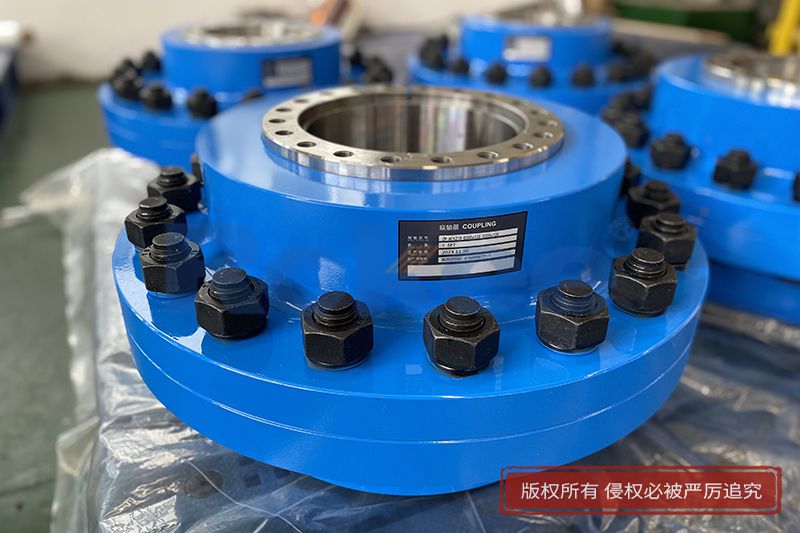
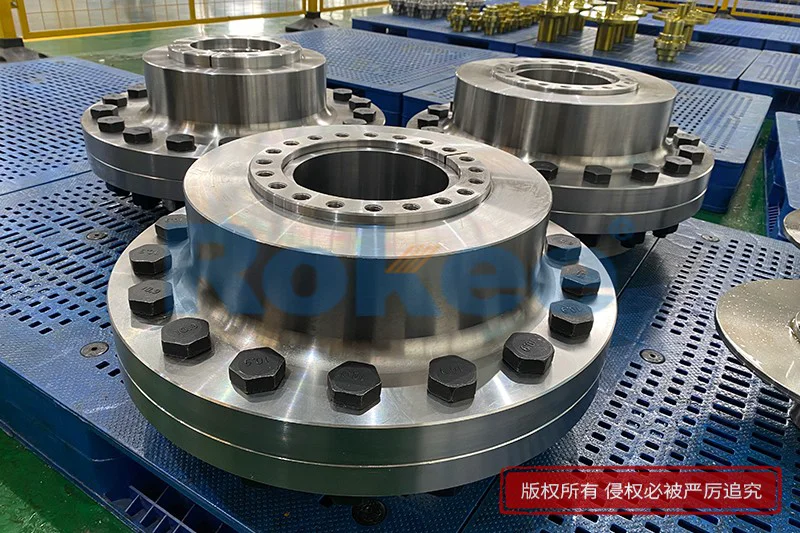
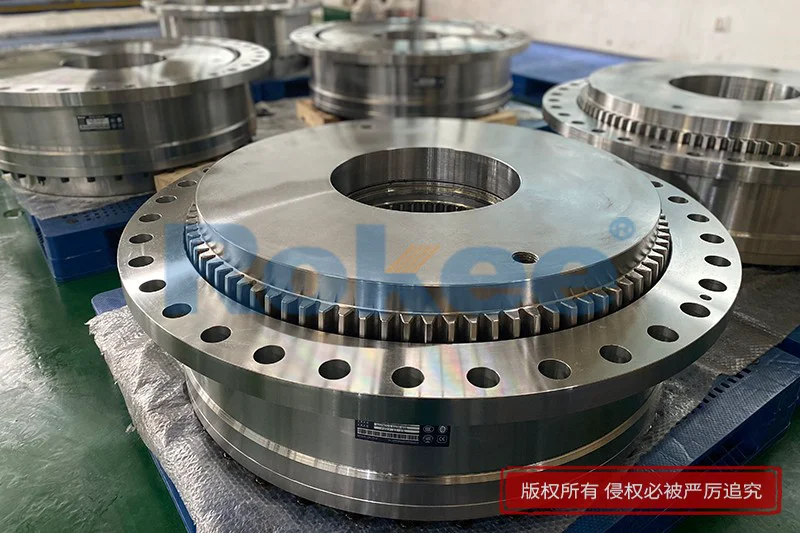
The basic structural composition of flange couplings follows a concise and practical mechanical design logic, with all components cooperating closely to complete the power transmission process. A standard flange coupling assembly mainly consists of two symmetrical flange half-couplings, fastening bolt groups, matching keys and auxiliary sealing gaskets. The two half-couplings are respectively fixed on the end sections of the driving shaft and the driven shaft through interference fit and key connection structures. The key plays a core role in circumferential positioning and torque transmission, eliminating relative rotational sliding between the shaft body and the flange hub, while the interference fit ensures tight axial combination of the coupling and the shaft to avoid axial displacement during high-speed operation. The end faces of the two flange discs are precisely machined to ensure flatness and fitting accuracy, and they are closely pressed together through uniformly distributed bolt groups. The clamping force generated by bolt fastening forms stable friction on the fitting end faces, which cooperates with the shear resistance of the bolts and the limiting effect of the key structure to jointly bear the torque load generated by mechanical operation. In some optimized structural designs, auxiliary positioning structures such as tenon and groove are added to the flange fitting surfaces, which further improves the alignment accuracy of the two half-couplings and enhances the overall anti-deformation ability during load operation.
The working principle of flange couplings is built on the comprehensive coordination of mechanical friction, shear force bearing and structural limiting mechanisms, realizing efficient and stable power transmission. When the driving equipment starts to operate and outputs rotational power, the driving shaft drives the fixed flange half-coupling to rotate synchronously through the key connection structure. The torque is transmitted to the driven flange half-coupling through the friction force of the fitting end faces and the shear force of the fastening bolts, and then drives the driven shaft to rotate synchronously, thereby completing the continuous transmission of rotational speed and torque between the two shafts. In the entire transmission process, the rigid integrated structure formed by the two flanges after fastening ensures that there is no relative displacement, angle deviation or speed difference between the connected shafts. This completely rigid transmission mode enables the coupling to maintain extremely high transmission accuracy, without speed loss or torque attenuation, which is particularly suitable for mechanical equipment that requires strict synchronization of shaft body operation. Although flange couplings are mainly designed for standard shaft connection scenarios, their optimized structural design can also bear a certain range of axial pressure and tiny displacement interference, ensuring stable operation of equipment under conventional working condition fluctuations.
According to structural characteristics, protective forms and applicable working conditions, flange couplings can be divided into several mainstream types, each with unique performance advantages and targeted application scenarios. The unprotected flange coupling is the most basic type with a simple structure, consisting only of two flanges and matching bolts and keys. It features low manufacturing difficulty and convenient assembly and disassembly, and is mostly applied in conventional indoor mechanical equipment with stable working conditions, no corrosive medium and low dust pollution. The protected flange coupling adds annular protective convex edges on the outer edge of the flange disc. This structure can effectively wrap the bolt and key connection parts, preventing external dust, debris and moisture from eroding the fasteners, while avoiding accidental contact with rotating parts during equipment operation, which improves operational safety and prolongs the service life of components. It is widely used in general industrial processing equipment with slightly complex working environments. The marine flange coupling is a specially optimized type for extreme working conditions, adopting reinforced integral forging technology and anti-corrosion surface treatment process. Its structural strength, sealing performance and salt corrosion resistance are significantly improved, adapting to high-humidity, high-salt-fog and high-vibration marine working environments, and is commonly used in ship power transmission and offshore engineering equipment.
The prominent performance advantages of flange couplings lay a solid foundation for their wide application in the industrial field. First of all, they possess extremely high transmission efficiency and accuracy. The fully rigid connection structure eliminates elastic deformation and relative sliding during operation, realizing zero-loss transmission of torque and rotational speed, which can fully meet the high-precision operation requirements of precision transmission equipment. Secondly, the overall structural rigidity is strong, with excellent load-bearing capacity and anti-overload performance. The integrated forging or casting process enables the coupling to bear huge instantaneous torque and continuous heavy load, adapting to various heavy-duty industrial production scenarios. In addition, the structural design is simple and standardized, with low manufacturing and processing difficulty, good structural stability and extremely low failure rate in long-term operation. The assembly, disassembly and maintenance processes are extremely convenient, without complex debugging steps, which can effectively reduce equipment downtime and later operation and maintenance costs. Moreover, the compact structural form saves installation space, with small overall size and stable structural state, and will not produce excessive vibration and noise during high-speed operation, having good operational stability and environmental adaptability.
Despite the numerous advantages, flange couplings also have inherent performance limitations determined by their rigid structural characteristics, which need to be fully considered in practical selection and application. The most notable limitation is the poor compensation ability for shaft body deviation. Due to the fully rigid connection mode, flange couplings can hardly compensate for axial displacement, radial deviation and angular misalignment between the two connected shafts. Once the installation alignment accuracy is insufficient or the shaft body produces deformation and deviation after long-term operation, additional alternating stress will be generated at the coupling connection parts, which will easily cause bolt loosening, flange end face wear, key body shear failure and other faults, and even lead to equipment vibration, noise and abnormal operation in severe cases. In addition, the rigid structure cannot buffer and absorb mechanical vibration and impact load. When the equipment starts, stops or bears instantaneous impact load, the vibration and impact force will be directly transmitted between the shafts without attenuation, which may cause certain fatigue damage to the shaft body, bearings and other matching components. Therefore, flange couplings are not suitable for equipment with frequent impact load, severe vibration or large shaft body deviation, and need to be replaced with flexible coupling products with deviation compensation and vibration buffering functions.
The installation accuracy and standardized operation process of flange couplings are key factors affecting their service performance and service life, and every link in the installation process needs to be strictly controlled. Before installation, all components need to be inspected comprehensively, including checking whether the flange end faces are flat and smooth, whether there are burrs, scratches and deformation defects, whether the key grooves and bolts are matched accurately, and whether the component surface has corrosion and damage. At the same time, the surface of the shaft body and the inner hole of the flange hub need to be cleaned to remove oil stains, rust and impurities, ensuring a clean and tight matching state. In the installation process, the coaxiality of the driving shaft and the driven shaft must be calibrated first to minimize radial and angular deviation. After the flange half-couplings are respectively sleeved on the shaft ends and positioned by keys, the two flanges are preliminarily fitted, and the bolts are penetrated in a symmetrical and staggered manner. The fastening of bolts needs to follow the principle of uniform force application, and graded tightening is carried out in sequence to ensure that the clamping force of each bolt is consistent, avoiding structural deformation and local stress concentration caused by uneven force. After the completion of installation, a trial operation test is required to check whether the equipment has abnormal vibration, noise and shaft body jitter, and fine-tune the bolt tightness and alignment state to ensure stable operation.
Daily maintenance and regular inspection are crucial to maintain the long-term stable operation of flange couplings and extend their service life. In the daily operation process, the operational state of the coupling should be observed regularly, focusing on checking whether there is abnormal vibration and noise during equipment operation, which is the most intuitive feedback of abnormal coupling operation. Regular inspection work mainly includes bolt fastening inspection, end face fitting state detection and component wear monitoring. Due to the long-term alternating load and vibration during equipment operation, the fastening bolts are prone to loosening, so regular reinforcement and fastening are required to prevent connection failure caused by bolt loosening. The fitting end faces of the flanges will produce slight friction wear during long-term torque transmission, and regular detection of wear degree is needed. When excessive wear, scratches and gaps appear on the end faces, the components should be repaired or replaced in time to avoid affecting transmission accuracy. In addition, the key connection parts and shaft matching parts need to be checked for wear and deformation, and anti-rust treatment should be carried out on the component surface regularly for equipment working in humid and corrosive environments to avoid structural corrosion damage.
With the continuous upgrading of modern industrial manufacturing technology and the gradual improvement of industrial equipment performance requirements, flange coupling technology is also constantly optimized and innovated, showing new development trends in structural design, material application and performance optimization. In terms of material selection, traditional ordinary carbon steel materials are gradually replaced by high-strength alloy steel, stainless steel and wear-resistant and corrosion-resistant composite materials. The new materials have higher structural strength, better wear resistance, corrosion resistance and fatigue resistance, which can adapt to more extreme high-temperature, low-temperature, high-corrosion and high-load working environments and expand the application scope of flange couplings. In structural design, on the premise of retaining the original rigid transmission advantages, micro-deviation compensation structures and vibration damping auxiliary structures are added to individual optimized models, which appropriately make up for the inherent shortcomings of rigid structures, enabling the couplings to adapt to working conditions with slight shaft deviation and vibration interference. At the same time, the integrated lightweight design has become a mainstream trend. Through finite element analysis and structural optimization, unnecessary structural redundancy is reduced while ensuring structural strength, realizing lightweight of components, reducing equipment operation load and improving transmission efficiency.
In the field of industrial application, flange couplings have always occupied an important position in mechanical transmission systems due to their irreplaceable rigid transmission advantages. In power generation equipment such as steam turbines and generators, they undertake the high-precision and high-stability power transmission task between main shafts, ensuring the synchronous and stable operation of power generation units. In petrochemical industrial equipment such as pumps, compressors and mixers, they adapt to continuous and stable heavy-load operation working conditions, providing reliable connection guarantee for long-term uninterrupted operation of equipment. In heavy engineering machinery such as cranes, excavators and rolling mills, their high torque bearing capacity and structural stability can fully meet the power transmission requirements of heavy-load operation. In marine equipment, the specially optimized anti-corrosion and high-strength flange couplings cope with harsh marine working environments and ensure the safe and stable operation of ship power systems. It can be said that wherever high-precision, high-stability and high-torque rigid shaft connection is required, flange couplings are the preferred connection components.
In conclusion, flange couplings, as classic rigid mechanical transmission components, have maintained strong industrial vitality relying on their simple and reliable structure, stable transmission performance, high load-bearing capacity and convenient operation and maintenance characteristics. Although they have certain limitations in deviation compensation and vibration buffering, their unique advantages in high-precision rigid transmission make them still indispensable core components in modern industrial transmission systems. With the continuous progress of material technology, processing technology and structural optimization design, the comprehensive performance of flange couplings will be further improved, and their adaptability to complex working conditions will be continuously enhanced. In the future industrial manufacturing and mechanical equipment upgrading process, flange couplings will continue to play an important basic supporting role, providing solid and reliable guarantee for the stable and efficient operation of various mechanical equipment and promoting the stable development of industrial transmission technology.
« Flange Couplings » Update Date: 2026/7/15
Contact
If you require custom machined couplings, please contact Rokee via the contact information below for inquiries.
Email: https://www.gshmdpq.com
 WeChat