Universal Drive Shafts
Rokee is a manufacturer of universal drive shafts from china, we can provide non-standard custom universal drive shafts based on parameters or drawings supplied by customers, with export support available.
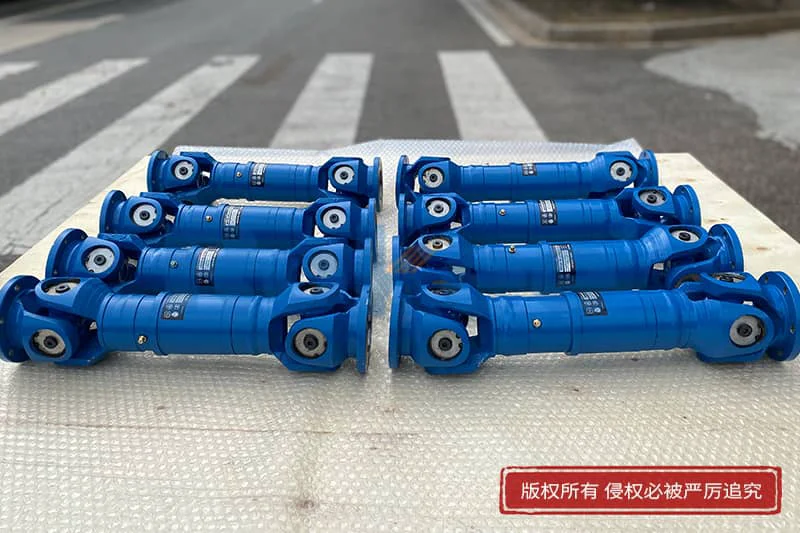
Mechanical power transmission constitutes the core foundation of all modern industrial equipment, mobile machinery, and transportation systems. Every rotating mechanical device, from precision industrial automation equipment to heavy-duty engineering machinery, relies on stable and efficient energy conversion and motion transmission to achieve functional operation. In practical engineering scenarios, it is nearly impossible to maintain absolute coaxial alignment between power input and output components due to structural layout constraints, equipment installation deviations, operational vibration, material thermal deformation, and dynamic load changes. Rigid transmission structures, which require strict linear alignment of rotating shafts, often face severe limitations in such complex working conditions, prone to excessive mechanical stress, violent vibration, accelerated component wear, and even system failure. As a classic flexible transmission component optimized for non-coaxial power transmission, the universal drive shaft has become an indispensable key link in modern mechanical systems, effectively solving the universal engineering problem of torque and motion transmission between spatially offset, angularly deflected, and axially displaced rotating parts.


The core value of the universal drive shaft lies in its unique adaptive transmission capability that balances structural rigidity and operational flexibility. Different from fixed rigid shafts that can only operate stably under ideal coaxial conditions, this mechanical assembly can continuously and stably transmit rotational torque and kinetic energy when the connected driving and driven shafts produce angular deflection, axial telescopic displacement, and slight radial offset during operation. This distinctive characteristic enables mechanical systems to break free from the constraints of fixed-axis transmission design, greatly optimizing the structural layout flexibility of mechanical equipment, reducing assembly precision requirements, and improving the environmental adaptability and operational stability of machinery under complex and variable working conditions. After centuries of technical iteration and structural optimization, the universal drive shaft has evolved from a simple articulated transmission mechanism in the early mechanical era to a standardized, high-precision, and highly reliable core component, widely covering transportation, industrial manufacturing, agricultural machinery, engineering construction, and special mechanical equipment fields.
The basic structural composition of the universal drive shaft follows a mature and rigorous mechanical design logic, with each component undertaking precise functional division to jointly realize flexible and efficient power transmission. The overall assembly mainly consists of universal joint assemblies, intermediate transmission shafts, telescopic adjustment structures, and sealing and damping accessories. The universal joint is the core functional unit of the entire system, typically adopting a cross-joint structure composed of a cross shaft, bearing components, and joint forks. The cross shaft serves as the central hinge, connecting the driving fork and the driven fork, and can realize free rotational deflection in multiple spatial directions, providing the basic angular compensation capability for power transmission. The precision rolling bearings installed at the four ends of the cross shaft effectively reduce the friction resistance during relative rotation of the joints, avoid dry friction and mechanical jamming, and ensure smooth and low-loss transmission of rotational motion.
The intermediate transmission shaft is the main bearing and force-transmitting component of the universal drive shaft, undertaking the task of long-distance torque transmission. According to different application scenarios and load requirements, the shaft body adopts high-strength alloy steel materials processed through precision forging, heat treatment, and dynamic balancing calibration. The integrated processing technology eliminates structural defects such as internal pores and cracks of the shaft body, ensuring excellent torsional rigidity and fatigue resistance, and avoiding bending deformation or fracture failure under long-term high-load operation. The telescopic structure is another key functional design of the universal drive shaft, usually composed of matching spline shafts and spline sleeves. It can freely stretch and contract within a certain stroke range to compensate for the axial distance change between the power source and the executing component caused by equipment vibration, component wear, or mechanical deformation, effectively avoiding additional axial stress accumulation in the transmission system and protecting the stability of the overall mechanical structure.
Auxiliary components such as sealing sleeves, dust covers, and damping gaskets play a vital role in improving the service life and operational reliability of the universal drive shaft. The closed sealing structure can isolate external dust, moisture, corrosive media, and granular impurities, preventing abrasive wear and electrochemical corrosion of internal bearings and hinge structures. The damping and buffering accessories can absorb part of the vibration and impact load generated during equipment start-up, variable-speed operation, and load mutation, reduce the vibration amplitude and noise of the transmission system, and make power output more stable and uniform. The reasonable matching of the overall structure enables the universal drive shaft to maintain stable transmission efficiency under complex working conditions such as high speed, heavy load, and variable deflection angles, realizing the perfect integration of flexibility, rigidity, and durability.
The operating principle of the universal drive shaft is based on the spatial kinematic characteristics of multi-degree-of-freedom hinge motion, and its stable transmission effect depends on the scientific matching of double universal joint structures. A single universal joint has inherent non-uniform motion characteristics: when there is an angular deflection between the driving shaft and the driven shaft, the instantaneous rotational speed of the driven shaft will fluctuate periodically, resulting in unstable torque output and mechanical vibration. To eliminate this inherent defect, most practical universal drive shaft systems adopt a double-joint symmetric layout, which effectively compensates for the speed fluctuation generated by a single joint through the reverse motion matching of the two universal joints. The core matching conditions for synchronous and stable transmission include equal deflection angles of the two universal joints and the inner forks of the two joints being kept on the same plane, so that the speed fluctuation generated by the first joint can be completely offset by the second joint, realizing constant-speed and stable power transmission between the input and output shafts.
In actual operation, the universal drive shaft presents excellent dynamic adaptive performance. When the mechanical equipment is in static operation with a small load, the deflection angle of the joint is small, the transmission resistance is low, and the power loss is minimal. With the change of equipment working conditions, such as the jitter and displacement of the mechanical bracket during high-load operation, the uneven ground contact of mobile equipment, or the thermal expansion and contraction of components after long-time operation, the universal joint can automatically adjust the hinge angle and axial length in real time to adapt to the changed spatial position relationship between the shafts. This real-time dynamic adjustment capability ensures that the power transmission chain always maintains a continuous and effective connection, avoiding power interruption, transmission lag, or component damage caused by shaft position deviation. Whether it is continuous high-speed rotating operation or intermittent impact load operation, the universal drive shaft can maintain consistent transmission accuracy and operational stability.
The wide application of universal drive shafts covers almost all mechanical scenarios that require flexible power transmission, showing strong environmental adaptability and functional versatility. In the field of road transportation, it is a core component of the vehicle transmission system, responsible for transmitting the torque output by the engine and gearbox to the drive axle, driving the wheels to rotate. During the driving process of vehicles, especially rear-wheel-drive and off-road vehicles, the body jitter, suspension stretching, and uneven road surface will cause real-time changes in the relative position between the gearbox and the drive axle. The universal drive shaft can adapt to this dynamic position change, ensuring stable power output during vehicle acceleration, deceleration, and bumpy driving, and improving the overall driving stability and power response speed of the vehicle.
In engineering machinery and special vehicle fields, the application advantages of universal drive shafts are more prominent. Heavy-duty construction machinery such as excavators, loaders, and cranes often operates in harsh environments with complex terrain and variable loads, and the mechanical structure is prone to large vibration and displacement during operation. The high-strength universal drive shaft can withstand huge impact torque and variable deflection loads, ensuring the normal operation of the power transmission system under extreme working conditions. Special vehicles such as sanitation vehicles, fire-fighting vehicles, and engineering operation vehicles also rely on universal drive shafts to realize power transmission between different functional components, meeting the power demand of multi-functional mechanical operation and improving the operational reliability of special equipment in complex scenarios.
The field of industrial manufacturing and automated production lines also cannot do without universal drive shaft technology. In automated assembly equipment, conveying machinery, and precision processing equipment, there are a large number of spatially distributed power transmission links that are not coaxial. The universal drive shaft can realize long-distance and multi-angle power transmission, optimize the spatial layout of industrial equipment, make the mechanical structure more compact and reasonable, and improve the integration degree of automated production equipment. At the same time, its stable transmission performance can ensure the consistency of mechanical motion accuracy, avoid processing errors and equipment jitter caused by unstable power transmission, and provide a reliable guarantee for high-precision industrial production and efficient operation of production lines.
Agricultural machinery is another important application scenario for universal drive shafts. Farmland operation equipment such as tractors, harvesters, and tillers needs to adapt to rugged farmland terrain and complex operation postures, and the relative position between the power output end and the working component changes frequently. The universal drive shaft can flexibly adapt to various angular deflections and axial displacements, ensuring that agricultural machinery can maintain stable power output during walking, steering, and variable-depth operation, improving the operational efficiency and environmental adaptability of agricultural equipment, and meeting the power transmission needs of diversified farmland operations.
Although the universal drive shaft has high structural reliability and stable operating performance, long-term high-load operation, harsh working environments, and improper use and maintenance will still lead to component wear and performance degradation, affecting the overall operating state of the mechanical system. Common operational problems include universal joint hinge wear, bearing aging and jamming, spline telescopic structure abrasion, and sealing failure. Long-term angular deflection operation will cause periodic friction and impact on the cross shaft and bearing components, resulting in increased assembly clearance, reduced transmission accuracy, and obvious vibration and noise during equipment operation. Dust and moisture intrusion caused by sealing damage will accelerate component corrosion and abrasive wear, shorten the service life of the drive shaft, and even cause fracture failure in severe cases, leading to equipment shutdown.
Scientific daily maintenance and standardized use are key to extending the service life of universal drive shafts and maintaining stable transmission performance. Regular lubrication maintenance is the most basic and critical maintenance measure. Filling high-performance lubricating grease into the universal joint bearing and spline telescopic structure can effectively reduce friction and wear between moving parts, reduce operational resistance and heat generation, and avoid dry friction damage. At the same time, it is necessary to regularly check the sealing integrity of the drive shaft assembly, replace aging and damaged sealing accessories in a timely manner, and ensure the internal working environment is clean and dry. Regular visual inspection and dynamic detection of the drive shaft body are required to check for bending deformation, surface cracks, and excessive assembly clearance, and perform dynamic balancing calibration regularly to avoid vibration amplification caused by unbalanced shaft body rotation.
In the process of equipment use, standardized operation can effectively reduce the failure probability of universal drive shafts. Avoid long-term overload operation and sudden start and stop with large load, so as to prevent instantaneous impact torque from causing structural damage to the drive shaft. For mechanical equipment working in high-corrosion, high-dust, and high-humidity environments, strengthen the frequency of inspection and maintenance, and do a good job in external anti-corrosion and dust-proof protection of the drive shaft. Timely replacement of severely worn components can avoid the deterioration of faults and ensure the long-term stable operation of the transmission system. Perfect maintenance management can not only reduce equipment failure rates and maintenance costs, but also maintain the efficient transmission performance of the universal drive shaft and extend its comprehensive service life.
With the continuous progress of mechanical manufacturing technology and the upgrading of industrial equipment, the technical iteration of universal drive shafts is also accelerating, moving towards high precision, high strength, lightweight, and long-life development directions. In terms of material technology, new high-strength wear-resistant alloy materials and composite materials are gradually applied to drive shaft manufacturing, which have higher torsional strength, fatigue resistance, and corrosion resistance than traditional materials, and can adapt to more extreme working conditions. In terms of processing technology, precision CNC machining, integral forging forming, and advanced heat treatment processes effectively improve the structural accuracy and mechanical performance of the drive shaft, reduce structural defects, and realize lightweight design while ensuring strength, reducing equipment operating energy consumption.
Structural optimization design further improves the comprehensive performance of universal drive shafts. The optimized universal joint hinge structure reduces motion friction resistance and improves transmission efficiency; the improved telescopic spline structure has higher matching precision and smaller abrasion, realizing more accurate axial displacement compensation; the integrated sealing and damping structure enhances environmental adaptability and vibration reduction effect. At the same time, with the development of intelligent manufacturing technology, some universal drive shaft products are combined with monitoring sensing technology, which can realize real-time monitoring of operating temperature, vibration amplitude, and torque load, providing data support for equipment predictive maintenance and realizing intelligent operation and management of transmission components.
As a classic flexible power transmission component that has been tested by long-term engineering practice, the universal drive shaft has irreplaceable application value in the field of mechanical engineering. It solves the core technical problem of power transmission under non-ideal coaxial conditions for various mechanical equipment, provides a flexible, efficient, and reliable connection scheme for the power transmission chain of modern machinery, and lays an important foundation for the diversification and high-performance development of mechanical equipment. From traditional industrial machinery and transportation equipment to modern intelligent manufacturing and special engineering equipment, the universal drive shaft always undertakes the basic transmission task, supporting the stable operation of countless mechanical systems.
In the future, with the continuous development of high-end equipment manufacturing, new energy equipment, and intelligent engineering machinery, the performance requirements for universal drive shafts will continue to improve, and technological innovation and structural upgrading will continue to advance. Through continuous optimization of materials, structures, and processing technologies, universal drive shafts will achieve higher transmission efficiency, longer service life, stronger environmental adaptability, and more intelligent operating performance, continue to expand its application boundaries in emerging industrial fields, and provide more solid technical support for the high-quality development of modern mechanical engineering and industrial manufacturing industries.
« Universal Drive Shafts » Update Date: 2026/7/15
Contact
If you require custom machined couplings, please contact Rokee via the contact information below for inquiries.
Email: https://www.gshmdpq.com
 WeChat