Crane Couplings
Rokee is a manufacturer of crane couplings from china, we can provide non-standard custom crane couplings based on parameters or drawings supplied by customers, with export support available.
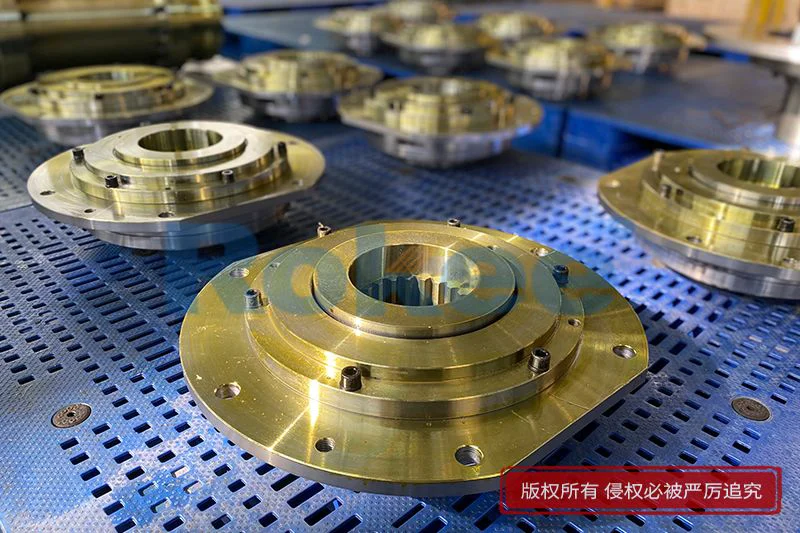
In the complex mechanical system of modern industrial cranes, numerous precision components work in tandem to convert electrical energy into stable mechanical power, enabling the lifting, traveling, and slewing operations of heavy equipment. Among these components, crane couplings stand out as an indispensable core transmission part, serving as the critical connecting bridge between rotating shafts in crane drive systems. Though often overlooked in conventional mechanical analysis due to their compact structural form, these specialized coupling components determine the operational stability, service life, and safety performance of the entire crane equipment. Unlike ordinary industrial couplings designed for stable and low-load operating environments, crane couplings are uniquely engineered to adapt to the harsh working conditions of frequent start-stop cycles, sudden load fluctuations, strong instantaneous impact, and continuous vibration, providing reliable power transmission guarantee for various heavy-duty lifting scenarios.


Essentially, a crane coupling is a professional mechanical component dedicated to connecting driving shafts and driven shafts within crane transmission structures. Its basic functional logic lies in efficiently transmitting torque and rotational power while coordinating the collaborative operation of scattered power components. In the overall layout of crane mechanical structures, couplings are mostly installed between motors and reducers, between adjacent reducers, or between reducers and winding drums. This core installation position makes them the central hub of power transmission. Without qualified coupling components, the power output by the driving device cannot be stably transmitted to the executing mechanism, and the basic lifting and moving functions of the crane will be completely paralyzed. What distinguishes crane couplings from general mechanical couplings is their adaptive design for the extreme working characteristics of lifting equipment, which covers misalignment compensation, impact load absorption, vibration damping, and overload protection, forming a multi-dimensional technical guarantee system for crane operation.
Shaft misalignment is one of the most common and unavoidable mechanical problems in crane long-term operation. Affected by manufacturing errors of equipment components, assembly deviations, structural deformation under long-term heavy load, and thermal expansion and contraction during mechanical operation, the connected shafts of crane drive systems often produce different degrees of axial, radial, and angular misalignment. In traditional rigid transmission structures, tiny misalignments will be continuously amplified during high-speed rotation and heavy-load operation, resulting in additional shear force and friction torque on the shaft body, bearings, and gear components. This long-term abnormal load will accelerate component wear, cause shaft body fatigue deformation, and even trigger mechanical jamming and equipment failure in severe cases. Crane couplings are precisely optimized to solve this industry pain point. Through flexible structural design and precise mechanical matching, they can effectively tolerate and compensate for various slight misalignments generated in the shafting transmission process, eliminate additional mechanical stress caused by misalignment, and protect key transmission components from abnormal wear and impact damage.
Impact load absorption is another core technical attribute of crane couplings and a key indicator to measure their service performance. Cranes belong to intermittent operation equipment, and their working process is accompanied by frequent starting, braking, sudden lifting, and sudden stopping of heavy loads. At the moment of starting, the static load of heavy materials instantly converts into dynamic load, generating huge instantaneous torque impact on the transmission system; during braking and load landing, the inertial force of the mechanical structure and the gravity of the load will also form reverse impact loads on the shafting. These periodic impact forces are the main cause of fatigue damage to crane transmission components. High-performance crane couplings rely on their unique structural elasticity and buffer characteristics to effectively absorb and decompose instantaneous impact energy, avoid direct rigid collision between driving and driven parts, and realize smooth transition of torque transmission. This buffering function greatly reduces the fatigue loss of the entire transmission system, significantly prolongs the service life of motors, reducers, and bearings, and effectively avoids sudden equipment failures caused by impact fatigue.
Vibration damping and noise reduction capabilities further enhance the operational stability of crane equipment. During the continuous operation of cranes, mechanical vibration generated by gear meshing, shaft rotation, and load shaking will be transmitted along the transmission shafting. If the vibration cannot be effectively isolated, it will resonate with the overall mechanical structure of the crane, resulting in intensified equipment jitter, increased operating noise, and even affecting the accuracy of load lifting and positioning. Crane couplings have excellent vibration isolation performance, which can block the transmission path of mechanical vibration between adjacent components, limit vibration within a single structural unit, and prevent local vibration from spreading to the entire equipment system. While reducing equipment vibration and operating noise, this function also optimizes the working environment of mechanical parts, avoids structural loosening and precision deviation caused by long-term vibration, and ensures the stable and accurate operation of cranes in frequent working cycles.
With the continuous upgrading of industrial manufacturing standards, the structural types of crane couplings have been continuously optimized and iterated, forming a variety of product forms adapted to different crane types and working intensities. Each structural type has its unique technical characteristics and application scenarios, covering low-speed heavy-load, high-frequency operation, and special braking matching working conditions. Gear couplings are one of the most widely used heavy-duty crane coupling types. They adopt the meshing transmission form of internal and external gears, with compact structure, large torque transmission capacity, and good misalignment compensation performance. This kind of coupling can bear ultra-heavy load impact and is mostly suitable for large overhead cranes, gantry cranes, and tower cranes used in ports, mines, and large construction scenarios, adapting to long-term high-intensity heavy-load operation.
Brake wheel couplings are a specialized functional coupling integrating power transmission and braking matching, which is specially designed for crane braking system matching. Different from ordinary transmission couplings, this structure integrates the brake wheel structure into the coupling body, which can complete torque transmission while cooperating with the crane’s braking device to realize rapid and stable braking of the equipment. It perfectly solves the problem of unstable braking and easy sliding of heavy-load cranes, and is widely used in crane traveling and lifting mechanisms with high braking accuracy and safety requirements. Universal shaft couplings, on the other hand, rely on the cross shaft hinge structure to realize large-angle angular misalignment compensation, which is suitable for crane parts with large shaft position deviation and complex motion trajectories, ensuring constant-speed and stable torque transmission in variable-angle operation and avoiding jitter and power loss during equipment operation.
In addition to structural diversity, the material selection and precision manufacturing process of crane couplings also determine their core performance and durability. Qualified crane couplings are mostly made of high-strength alloy steel with strict forging and heat treatment processes. After quenching and tempering treatment, the material has high tensile strength, impact toughness, and wear resistance, which can resist long-term heavy-load friction and instantaneous impact damage. The precision machining process ensures the matching accuracy of gear meshing, shaft hole assembly, and flexible components, reducing assembly gaps and transmission errors. High-precision structural matching not only improves the efficiency of torque transmission but also avoids abnormal noise and vibration caused by loose matching, realizing low-loss and high-stability power output. At the same time, the surface anti-corrosion and wear-resistant treatment of couplings enables them to adapt to harsh working environments such as outdoor humidity, dust, and industrial corrosive gas, avoiding rust, corrosion, and surface wear in long-term outdoor and factory operations, and maintaining stable performance for a long time.
The application value of crane couplings runs through all mainstream crane equipment and industrial scenarios. In the construction industry, tower cranes, mobile cranes, and crawler cranes undertake the lifting and handling of steel structures, concrete components, and large construction machinery. The stable operation of their lifting, slewing, and traveling mechanisms all depends on the reliable transmission performance of couplings, which ensures the accurate positioning and safe handling of heavy materials in complex construction environments. In port and logistics industries, overhead cranes and gantry cranes work continuously for a long time, undertaking the loading and unloading of container goods and bulk materials. Couplings need to adapt to high-frequency start-stop and ultra-heavy load operation, providing continuous and stable power transmission support for efficient port operation.
In mining and metallurgical industries, cranes operate in harsh environments with heavy dust, high humidity, and large load fluctuations. The impact resistance and anti-fatigue performance of couplings can effectively cope with frequent load changes and harsh environmental interference, ensuring the stable operation of mining lifting equipment. In factory workshops, small and medium-sized overhead cranes used for material handling and equipment installation also rely on couplings to realize flexible and stable power transmission, improving the operating efficiency and safety of workshop handling operations. It can be said that all scenarios involving crane heavy-load lifting and mechanical transmission are inseparable from the technical support of crane couplings, whose performance directly affects the operational efficiency and safety level of the entire industrial production link.
Scientific type selection and standardized operation are crucial to giving full play to the performance of crane couplings. In the equipment design and supporting stage, it is necessary to select coupling types and specifications according to the crane’s load grade, operating frequency, working environment, and transmission mechanism form. For heavy-load and high-frequency operation scenarios, priority should be given to heavy-duty gear couplings with strong impact resistance and large torque capacity; for mechanisms with high braking requirements, brake wheel couplings should be matched; for transmission parts with large shaft misalignment, universal couplings with good compensation performance are more suitable. Blind type selection and mismatching will lead to insufficient coupling bearing capacity, poor compensation effect, and premature failure, which will affect the normal operation of the entire crane equipment.
Daily maintenance and overhaul are important guarantees to extend the service life of crane couplings and maintain equipment stability. In the daily operation and maintenance of cranes, the operating state of couplings needs to be checked regularly, including whether there is abnormal vibration, noise, and temperature rise during operation, whether the connecting parts are loose, and whether the transmission components are worn or fatigued. For gear couplings, regular lubrication maintenance is required to ensure sufficient lubricating oil between meshing gears, reduce friction and wear, and avoid gear biting and transmission failure caused by lack of lubrication. For flexible and buffer structural couplings, the aging and deformation of buffer components should be checked regularly, and damaged parts should be replaced in time to ensure the continuous and stable buffer and vibration damping performance.
Timely troubleshooting and maintenance can effectively avoid major mechanical failures. In the actual operation of cranes, common coupling failures include abnormal vibration caused by excessive misalignment, impact noise caused by loose assembly, power transmission lag caused by gear wear, and component damage caused by overload impact. Once abnormal conditions are found, the equipment should be shut down for inspection in time, and the root cause of the failure should be eliminated through shaft alignment, fastening assembly, component replacement, and lubrication maintenance. Standardized maintenance can not only avoid equipment shutdown losses caused by coupling failures but also eliminate potential safety hazards in advance, ensuring the safe and stable operation of crane equipment for a long time.
From the perspective of industrial mechanical system optimization, crane couplings are not only a simple connecting component but also a key part of crane safety protection and energy efficiency improvement. A high-quality coupling can reduce mechanical transmission loss, improve power transmission efficiency, and reduce the energy consumption of crane operation while protecting key equipment components. At the same time, its overload buffer and vibration isolation performance can effectively reduce the failure rate of the entire transmission system, reduce equipment maintenance costs and downtime losses, and create stable operational benefits for industrial production. With the continuous development of intelligent and high-efficiency lifting equipment, the technical design of crane couplings is also constantly evolving towards high precision, high durability, and intelligent adaptability, adapting to higher-standard industrial lifting operation requirements.
In conclusion, crane couplings are small in size but bear great mechanical responsibilities in heavy-duty lifting systems. Their unique misalignment compensation, impact absorption, vibration damping, and stable transmission performance solve many practical pain points in crane mechanical operation. As an essential core component of modern crane equipment, they penetrate every link of crane power transmission, providing solid technical support for the safety, stability, and high efficiency of industrial lifting operations. In the future industrial upgrading process, with the continuous progress of material technology and mechanical design technology, crane couplings will continue to optimize their structural performance and adaptive capacity, continuously meeting the increasingly stringent working conditions and safety standards of modern heavy industry, and becoming an indispensable basic guarantee for the stable operation of lifting machinery in various industrial fields.
« Crane Couplings » Update Date: 2026/7/15
Contact
If you require custom machined couplings, please contact Rokee via the contact information below for inquiries.
Email: https://www.gshmdpq.com
 WeChat