Telescopic Shafts
Rokee is a manufacturer of telescopic shafts from china, we can provide non-standard custom telescopic shafts based on parameters or drawings supplied by customers, with export support available.

As an indispensable core component in modern mechanical transmission systems, telescopic shafts have become a key solution to solve dynamic position deviation and stable power transmission between mechanical parts. Unlike traditional rigid fixed-length transmission shafts, this type of mechanical component integrates flexible length adjustment and continuous torque transmission functions, perfectly adapting to the complex operating conditions of axial displacement, angular offset and structural vibration that are ubiquitous in industrial equipment, transportation machinery and automated production lines. With the continuous upgrading of mechanical equipment towards high precision, high efficiency and high stability, the performance value of telescopic shafts in optimizing transmission efficiency, reducing mechanical loss and extending equipment service life has become increasingly prominent, making them widely applied in various fields of mechanical manufacturing and engineering equipment.
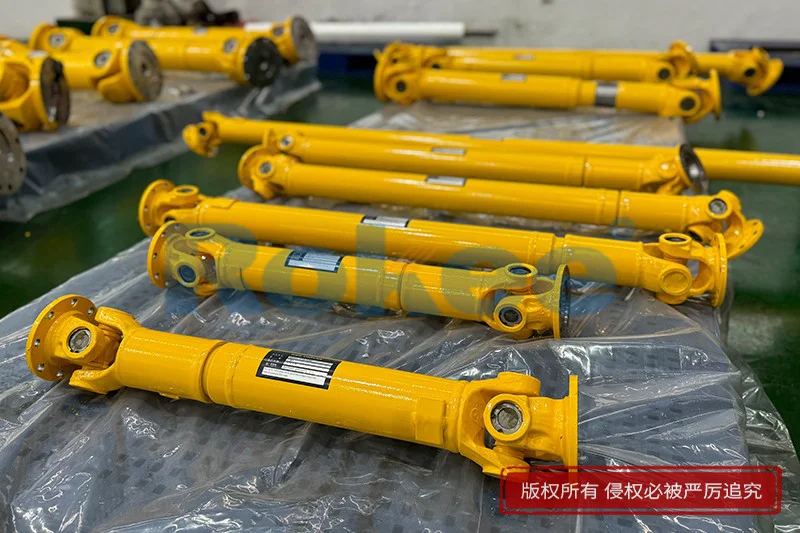


The unique working performance of telescopic shafts stems from their sophisticated and reasonable structural design, which takes into account both the rigidity required for torque transmission and the flexibility needed for length adjustment. The basic structure of a standard telescopic shaft is composed of nested concentric shaft bodies and precision matching transmission structures, mainly including an inner splined shaft and an outer sleeve. The inner shaft and outer sleeve are processed with high-precision matching spline structures on the contact surfaces. This structural design enables the inner shaft to slide freely along the axial direction inside the outer sleeve within a preset stroke range, while firmly locking the radial position to ensure synchronous rotation of the two parts. This dual functional feature is the core of the telescopic shaft’s ability to adjust length without interrupting power transmission.
In actual mechanical operation, the telescopic stroke of the shaft can adapt to the dynamic distance change between the driving end and the driven end of the equipment. Many mechanical systems will produce continuous or intermittent axial position changes during operation: vehicle suspension structures will compress and stretch with road fluctuations, industrial processing equipment will produce tiny structural displacements due to thermal expansion and cold contraction after long-term operation, and automated mobile machinery will have real-time position offsets during walking and working processes. The telescopic structure can effectively compensate for these axial displacements, avoiding the structural tension, transmission jamming and component deformation problems caused by fixed-length rigid shafts forced to bear position changes. At the same time, most telescopic shaft systems are matched with universal joint structures, which can cope with the angular misalignment between the driving shaft and the driven shaft within a certain range. The combination of axial telescopic compensation and angular deviation adaptation enables the transmission system to maintain stable power output in multi-dimensional offset working conditions, greatly improving the environmental adaptability of mechanical equipment.
Material selection is a decisive factor affecting the comprehensive performance of telescopic shafts, and different application scenarios correspond to targeted material matching schemes. For heavy-load industrial transmission and vehicle power transmission scenarios, high-strength alloy steel and carbon steel are the most mainstream materials. After overall quenching and tempering treatment and local surface hardening processing, these materials have excellent torsional resistance, tensile strength and surface wear resistance, which can withstand long-term high-torque impact and frequent telescopic friction. The optimized material hardness and toughness balance can effectively avoid tooth surface wear, shaft body distortion and fatigue fracture of the spline structure under heavy-load working conditions, ensuring the structural stability of the shaft body during long-cycle operation.
For light-duty mechanical equipment, precision automation instruments and small mobile devices, lightweight alloy materials such as aluminum alloys are widely used. While ensuring basic transmission rigidity, aluminum alloy materials greatly reduce the self-weight of the shaft body, which helps reduce the overall load of the equipment, improve the flexibility of mechanical operation and reduce energy consumption in the transmission process. In addition, for special working environments such as corrosion-prone chemical workshops, humid processing environments and low-temperature operating conditions, some telescopic shaft parts will adopt brass alloy or special engineering plastic materials. These special materials have good corrosion resistance, low-temperature toughness and self-lubricating properties, which can avoid rust, corrosion and friction clamping failures of the shaft body in harsh environments, and meet the stable operation requirements of special scenario equipment.
The processing precision of the matching parts directly determines the operating quality and service life of the telescopic shaft. The spline fit between the inner shaft and the outer sleeve is the key processing link. High-precision grinding and finishing processes are usually adopted to control the fit gap within a tiny tolerance range. Excessively large fit gaps will cause radial runout during shaft body rotation, resulting in transmission vibration, noise and accelerated wear of the spline surface; excessively small gaps will lead to unsmooth telescopic sliding, increased friction resistance and even jamming during equipment operation. Therefore, precise dimensional control and surface finish processing can ensure that the telescopic shaft maintains smooth sliding flexibility in the length adjustment state and achieves zero-delay synchronous rotation in the torque transmission state.
Lubrication design is also an essential part of the telescopic shaft structure. A reasonable lubrication system can form a stable oil film on the spline matching surface and the sliding friction surface, reducing dry friction and mechanical wear between parts. Effective lubrication can also play a role in heat dissipation during high-speed operation, avoiding performance degradation caused by local overheating of the shaft body. At the same time, the sealing structure matched with the lubrication system can effectively block external dust, metal debris, moisture and other impurities from entering the matching gap, preventing impurity abrasion and internal rust failure, and further improving the operational stability and durability of the telescopic shaft.
Telescopic shafts have extremely extensive application coverage in modern industrial systems and mechanical equipment, covering heavy industry manufacturing, transportation machinery, agricultural equipment, automated production and many other fields. In the field of commercial vehicles and engineering machinery, telescopic shafts are used as core power transmission components of chassis transmission systems. During the driving process of vehicles and the operation of engineering machinery, the frequent jitter and position change of the suspension system will cause real-time changes in the distance and angle between the engine power output end and the drive wheel. The telescopic and angle compensation functions of the shaft body can always maintain a stable power transmission connection, ensuring that the power output is continuous and uniform without power loss or transmission stalling.
In industrial production equipment, telescopic shafts are widely used in various rotating transmission equipment such as processing machine tools, conveying machinery and stirring equipment. In continuous industrial production, equipment will generate slight structural deformation and position offset due to long-term load operation and ambient temperature changes. The telescopic performance of the shaft can automatically compensate for these tiny displacements, avoid transmission failure caused by structural changes, and ensure the long-term stable operation of automated production lines. In food processing, chemical production and other industries with high environmental cleanliness requirements, the optimized sealed telescopic shaft structure can adapt to frequent cleaning and humid working environments, avoiding equipment failure caused by environmental factors and ensuring the continuity of production operations.
Agricultural machinery equipment is also an important application scenario for telescopic shafts. Field operation machinery such as harvesters and tillers often works in complex and uneven terrain. The fuselage will produce severe jitter and structural deformation during operation, and the working parts need to adjust the working height and angle in real time. The telescopic shaft can adapt to the dynamic position changes of agricultural machinery parts, maintain stable power transmission for cutting, tilling and conveying components, and improve the operational reliability of agricultural machinery in harsh field working conditions. At the same time, the wear-resistant and impact-resistant characteristics of the telescopic shaft can cope with the impact load and friction loss caused by complex field working conditions, reducing the failure rate of agricultural machinery.
Compared with traditional fixed-length transmission shafts and ordinary coupling transmission structures, telescopic shafts have irreplaceable functional advantages in mechanical transmission systems. First of all, it has excellent dynamic adaptability. Traditional rigid shafts can only adapt to fixed-position transmission conditions, and any slight structural displacement will cause additional mechanical stress, leading to accelerated component wear and even structural damage. Telescopic shafts can actively adapt to axial and angular position changes of equipment, eliminate additional transmission stress, and protect the entire transmission system and connected mechanical components.
Secondly, the telescopic shaft realizes the integration of multiple functions, simplifying the overall structure of the mechanical system. In the past, to solve the problem of dynamic displacement in transmission, mechanical systems often needed to be equipped with multiple auxiliary components such as flexible couplings and displacement compensation devices, which increased the complexity of the equipment structure, improved the failure probability and increased maintenance costs. The integrated design of the telescopic shaft integrates length adjustment, angle compensation and stable torque transmission into one component, which simplifies the equipment structure, reduces the number of parts, and improves the overall compactness and operational reliability of the mechanical system.
In terms of transmission efficiency, the high-precision matching structure of telescopic shafts ensures high-efficiency synchronous transmission. The spline structure with precise fit can realize almost zero-loss torque transmission, avoiding power loss caused by gap vibration and relative sliding in the transmission process. For high-speed operating equipment and high-precision processing equipment, this high-efficiency and stable transmission characteristic can effectively improve equipment operation accuracy and production efficiency. In addition, the stable transmission performance can reduce the vibration and noise of the equipment during operation, optimize the working environment of mechanical equipment, and meet the noise reduction and energy-saving requirements of modern mechanical design.
In terms of equipment operation safety and service life optimization, the adaptive adjustment function of telescopic shafts plays a vital role. When the equipment is impacted by external force or has abnormal structural displacement, the telescopic structure can buffer and release part of the impact force, avoid rigid impact damage to the power source and load components, and play a good buffer protection role for the entire mechanical system. This buffer protection performance greatly reduces the failure rate of key equipment components, extends the overall service life of the equipment, and reduces the downtime loss and maintenance cost caused by equipment failure.
Although telescopic shafts have excellent structural performance and functional advantages, their long-term stable operation is inseparable from standardized installation and daily maintenance management. In the installation process, it is necessary to ensure that the coaxiality and installation angle of the driving end and the driven end meet the design standards, avoid excessive initial offset caused by improper installation, and prevent abnormal wear and vibration of the shaft body in the early stage of operation. At the same time, the installation stroke of the telescopic shaft needs to be reasonably reserved according to the equipment operation range, ensuring that the shaft body has enough adjustment space during dynamic displacement, and avoiding structural damage caused by limit stretching or compression.
Daily maintenance focuses on lubrication maintenance and sealing inspection. Regular replacement and supplementation of lubricating grease can ensure the flexibility of telescopic sliding and rotational transmission, reduce friction and wear of matching parts. Regular inspection of the sealing structure can prevent the aging and failure of the sealing ring, avoid impurities and moisture from entering the interior of the shaft body, and prevent internal corrosion and spline abrasion. In addition, regular detection of shaft body runout, torsion resistance and surface wear degree can timely find potential failure risks such as slight deformation and local wear of the shaft body, and carry out maintenance and replacement in advance to ensure the continuous and stable operation of the equipment.
With the continuous development of mechanical manufacturing technology and the continuous improvement of industrial equipment performance requirements, the design and manufacturing technology of telescopic shafts is also constantly iterating and upgrading. At present, the industry is developing towards high precision, lightweight, high durability and intelligent adaptation. Through the optimization of material formula and heat treatment process, the strength and toughness of the shaft body are further improved, and the self-weight is reduced to realize lightweight and high-strength performance. Through the application of ultra-precision processing technology, the matching precision of spline parts is improved, the transmission vibration and noise are further reduced, and the transmission stability is optimized.
In addition, the application of new surface treatment technologies such as anti-wear coating and anti-corrosion treatment has greatly improved the environmental adaptability of telescopic shafts, enabling them to operate stably in extreme working conditions such as high temperature, low temperature, high humidity and strong corrosion. With the development of intelligent mechanical equipment, some telescopic shaft structures have begun to be equipped with wearable detection components, which can monitor the sliding state, torque load and wear degree of the shaft body in real time, realize early warning of failure, and further improve the operational safety and maintenance intelligence level of the equipment.
In the entire mechanical transmission system, the telescopic shaft is a small but crucial basic component. It does not produce power output, but it undertakes the important task of connecting power components and realizing stable power transmission. Its unique telescopic compensation and angle adaptation functions solve many pain points in traditional mechanical transmission, make up for the performance defects of rigid transmission structures, and provide a reliable technical guarantee for the stable operation of various complex mechanical equipment. From large engineering machinery and industrial production lines to small automated equipment and special precision instruments, telescopic shafts are playing an irreplaceable role, supporting the efficient and stable operation of modern mechanical systems.
In the future, with the continuous progress of industrial manufacturing and mechanical design technology, the performance of telescopic shafts will be further optimized, and their application fields will be more extensive. The continuous innovation of material technology, processing technology and intelligent monitoring technology will promote telescopic shafts to develop towards higher precision, longer service life and stronger environmental adaptability, and provide more solid basic component support for the upgrading and iteration of modern mechanical equipment and intelligent manufacturing industry.
« Telescopic Shafts » Update Date: 2026/7/15
Contact
If you require custom machined couplings, please contact Rokee via the contact information below for inquiries.
Email: https://www.gshmdpq.com
 WeChat