Rubber Tire Couplings
Rokee is a manufacturer of rubber tire couplings from china, we can provide non-standard custom rubber tire couplings based on parameters or drawings supplied by customers, with export support available.
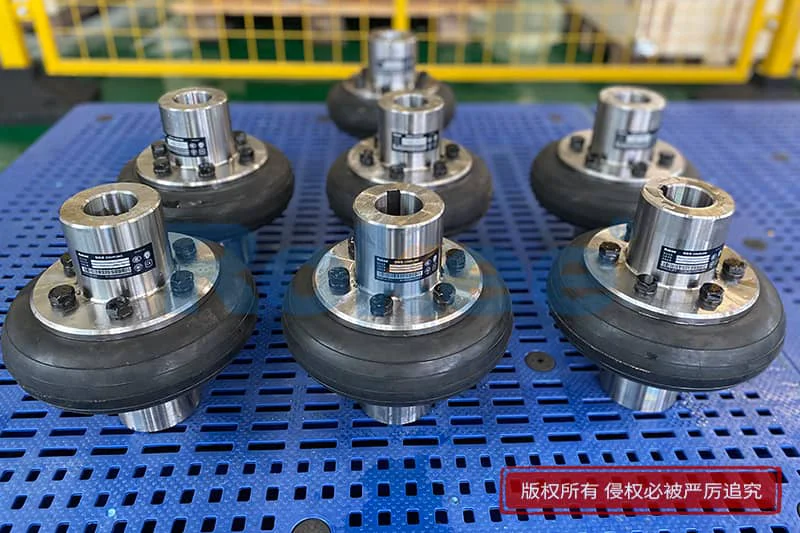
In the complex and dynamic field of mechanical power transmission, the stability, flexibility, and durability of connecting components directly determine the overall operating efficiency and service life of mechanical systems. Among various flexible transmission components, rubber tire couplings have emerged as a reliable and versatile solution, widely adopted in diverse industrial mechanical transmission scenarios that require shock buffering, vibration reduction, and misalignment compensation. As a typical elastomeric flexible coupling, it abandons the rigid connection mode of traditional rigid couplings and relies on the unique elastic deformation characteristics of rubber materials to realize torque transmission while solving multiple pain points in practical mechanical operation, including shaft misalignment, mechanical vibration, instantaneous impact load, and electrical conduction interference. Its simple structural design, excellent comprehensive performance, and low maintenance cost make it an indispensable core component in modern industrial transmission systems.
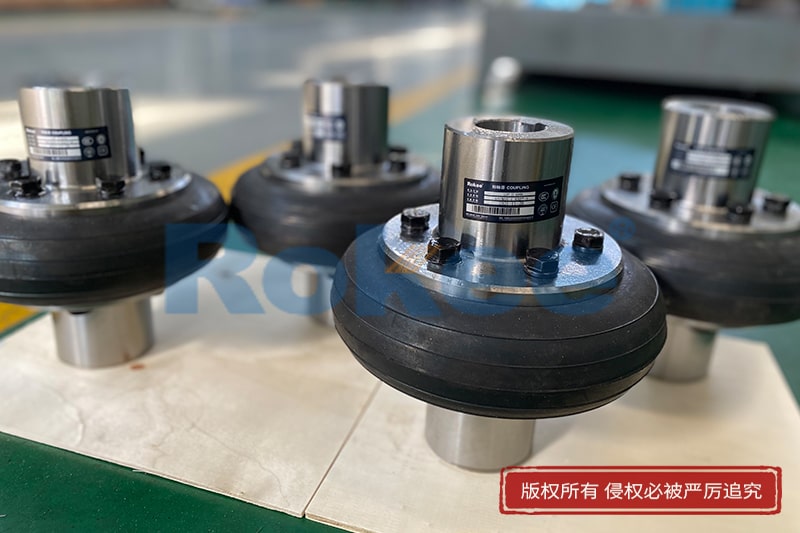


The basic structural composition of rubber tire couplings is concise and practical, with no overly complicated mechanical structures, which lays a solid foundation for its stable operation and convenient installation. The entire component system mainly consists of two symmetrical metal flanges and a vulcanized rubber tire elastic element clamped between the flanges. The metal flanges, usually made of high-strength cast iron or steel materials, possess excellent rigidity and structural stability, serving as the fixed connection carrier with the driving shaft and driven shaft respectively. The intermediate rubber tire element is the core functional part of the coupling, processed through professional vulcanization technology to form an integrated tire-shaped elastic structure. This special vulcanization process tightly combines the rubber matrix with the embedded auxiliary structures, effectively avoiding the problems of rubber delamination, cracking, and loose connection that are prone to occur in long-term operation. During assembly, the rubber tire element is accurately positioned between the two metal flanges, and the reserved fixing holes on the rubber body are aligned with the flange connecting holes, then fastened uniformly through high-strength bolts to form a complete transmission structure. This assembly method enables the coupling to form a unified force-bearing system during operation, ensuring efficient and stable torque transmission.
The working principle of rubber tire couplings is based on the elastic deformation performance of rubber materials and the friction extrusion coordination between structural components. In the operating state, the torque generated by the driving equipment is transmitted to the metal flange on the driving side first, and then the power is transferred to the rubber tire element through the fastening bolts and the contact surface of the flange. Driven by the torque, the rubber tire body produces controllable torsional shear elastic deformation, and the deformation force drives the driven-side flange to rotate synchronously, thereby realizing the continuous transmission of power between the two shafts. Unlike rigid couplings that rely on rigid contact for power transmission and cannot adapt to shaft displacement, the elastic deformation of the rubber tire can actively compensate for various misalignment deviations generated during the operation of the mechanical system. In actual mechanical operation, due to machining errors, installation deviations, equipment vibration, and thermal expansion and contraction during long-term operation, the driving shaft and driven shaft inevitably produce parallel offset, angular deflection, and axial displacement. These subtle deviations will cause additional alternating stress and friction loss in rigid transmission systems, accelerating component wear and even causing equipment vibration and noise. The rubber tire coupling can rely on its multi-directional elastic deformation capability to perfectly adapt to the above three types of shaft misalignment, eliminating additional mechanical stress caused by shaft displacement and ensuring the concentric and stable operation of the transmission system.
One of the most prominent performance advantages of rubber tire couplings is their excellent vibration damping and shock absorption capacity, which is far superior to many traditional rigid and semi-flexible couplings. In industrial production scenarios, most mechanical equipment will generate instantaneous impact loads and continuous vibration during start-stop, load switching, and variable-speed operation. For example, frequent start and stop of power equipment, sudden load changes of transmission devices, and impact resistance during equipment operation will all produce instantaneous mechanical impact force, which will be directly transmitted to the entire transmission chain in a rigid connection system, easily causing fatigue damage to shafts, bearings, gears, and other precision components, and reducing the overall service life of the equipment. The rubber tire element of the coupling has good elastic buffering performance and internal damping characteristics. When the system generates impact vibration, the rubber body can absorb most of the impact energy through self-torsional deformation and recover deformation slowly, converting mechanical impact energy into internal energy for dissipation. This effective energy absorption and buffering function greatly weakens the vibration and impact transmitted between the driving and driven ends, protects the precision components of the equipment from impact damage, and reduces the operating noise of the mechanical system. In addition, the special rubber material formula can maintain stable damping performance under different operating frequencies, realizing efficient damping of both low-frequency large-amplitude vibration and high-frequency micro-vibration, ensuring the quiet and stable operation of the equipment in the full working condition range.
Electrical insulation performance is another unique functional advantage of rubber tire couplings, which expands its application scope in special industrial scenarios. The rubber elastic element itself is an insulating material, which can form an effective electrical isolation barrier between the two metal flanges of the coupling. In the transmission system driven by motor equipment, the weak current leakage, static electricity, or induced current generated by the motor operation can be effectively isolated by the rubber tire coupling, preventing the current from being transmitted along the shaft to the driven equipment. This electrical isolation function avoids the electrochemical corrosion of precision mechanical components caused by current conduction, and also eliminates the potential safety hazards such as static accumulation and electric spark discharge in special working environments. Compared with other metal elastic couplings that cannot achieve electrical isolation, rubber tire couplings can effectively protect electrical and mechanical integrated equipment, reduce equipment failure rates caused by electrical conduction, and improve the safety and stability of system operation.
Rubber tire couplings have outstanding adaptability to complex working conditions, with stable performance in different operating environments and load states. First of all, it has extremely low rotational inertia due to its lightweight structural design. The overall weight of the coupling is far lighter than that of metal couplings of the same torque specification, which can effectively reduce the extra load of the transmission system during high-speed operation, reduce the power consumption of equipment operation, and improve transmission efficiency. This advantage is particularly prominent in high-speed rotating equipment, which can avoid the energy loss and vibration problems caused by excessive rotational inertia. Secondly, the optimized rubber material has excellent aging resistance, oil resistance, and temperature adaptability. After special formula modification and vulcanization treatment, the rubber body can maintain stable elastic performance for a long time in conventional industrial environments, not easy to age, harden, or crack due to long-term mechanical friction and environmental erosion. It can adapt to continuous operation in conventional temperature ranges and resist the erosion of common industrial lubricants, cutting fluids, and slight humid environments, ensuring long-term stable performance without attenuation.
In terms of installation and maintenance, rubber tire couplings have obvious economic and practical advantages, which are very suitable for large-scale industrial application. Its structural design is simple and intuitive, with fewer overall components and no complex matching structures. The installation process does not require high-precision professional debugging and complex tool assistance. Workers can complete alignment, positioning, and fastening operations efficiently according to the basic assembly process, which greatly shortens the equipment installation and commissioning cycle. More importantly, the coupling realizes a maintenance-free design in conventional working conditions. Different from gear couplings and chain couplings that need regular lubrication, oil injection, and wear detection, rubber tire couplings do not require any lubricating medium during operation. The elastic deformation of rubber is completely self-adaptive, no daily maintenance and regular refueling maintenance are needed, which greatly reduces the daily maintenance workload and operating cost of the equipment. In addition, the inspection of the coupling is extremely convenient. The external open structure makes the running state of the rubber tire element and the fastening state of bolts visible at any time. Staff can quickly check for rubber aging, cracking, bolt loosening and other hidden dangers through daily visual inspection, realizing rapid fault detection and avoiding major equipment failures caused by minor hidden dangers.
The excellent comprehensive performance makes rubber tire couplings widely used in various industrial transmission fields, covering general machinery, fluid equipment, power equipment, engineering machinery and many other scenarios. In fluid transmission equipment such as industrial pumps and compressors, the coupling connects the driving motor and the pump body/compressor shaft. It can compensate for the shaft misalignment caused by equipment installation deviation and long-term operation vibration, absorb the continuous vibration generated by fluid pulsation and mechanical operation, ensure the stable operation of fluid transmission equipment, and avoid pipeline vibration and fluid transmission instability caused by equipment jitter. In power generation and ventilation equipment such as industrial fans and generator sets, the lightweight and low-vibration characteristics of the coupling adapt to the long-term continuous high-speed operation state of the equipment, effectively reduce the operating noise and vibration of the unit, and improve the operational stability and service life of power equipment.
In engineering machinery and material handling equipment such as conveyors and transmission devices, the equipment often faces frequent start-stop, variable load operation and intermittent impact load working conditions. The excellent shock absorption and load buffering performance of rubber tire couplings can well adapt to this variable load working mode, buffer the instantaneous impact force generated by start-stop and load switching, protect the transmission shaft and bearing components from fatigue damage, and ensure the continuous and stable operation of material transmission. In marine and special industrial equipment, its electrical isolation performance and environmental adaptability play an important role, which can resist the humid and slightly corrosive working environment, avoid equipment damage caused by current conduction, and provide reliable transmission guarantee for special working condition equipment.
Although rubber tire couplings have many performance advantages, their service life and operating effect are still affected by installation accuracy, working conditions and daily inspection in practical application. Standardized installation is the premise to ensure its performance. Excessive shaft misalignment beyond the adaptive range will cause long-term excessive deformation of the rubber tire element, accelerate rubber fatigue and aging, and shorten the service life. Therefore, in the installation process, it is necessary to ensure the basic alignment accuracy of the two shafts to control the misalignment within the optimal adaptive range of the coupling. At the same time, although the rubber material has good environmental adaptability, long-term operation in extreme high temperature, severe corrosion and excessive load environments will still cause performance attenuation. In the face of extreme working conditions, targeted model selection and working condition optimization are needed to avoid long-term overload operation of the coupling.
Daily simple inspection and maintenance can further extend the service life of rubber tire couplings. In the routine equipment inspection process, it is only necessary to regularly observe the surface state of the rubber tire element, check whether there are cracks, aging hardening, local deformation and other abnormal phenomena, and confirm whether the fastening bolts are loose. For the rubber elements with slight aging signs, the operation state can be monitored in real time to arrange replacement in advance; for loose bolts, timely fastening can avoid eccentric wear and abnormal vibration of the coupling. This simple maintenance mode does not consume a lot of manpower and material resources, but can effectively avoid sudden failure of the coupling and ensure the long-term stable operation of the mechanical transmission system.
With the continuous upgrading of modern industrial machinery towards high efficiency, low noise and long life, the market demand for high-performance flexible transmission components is constantly improving. As a mature and reliable flexible coupling, rubber tire couplings are constantly optimized in material formula and structural design with the development of industrial technology. The upgraded rubber materials have better fatigue resistance, high temperature resistance and deformation recovery ability, which can adapt to more complex working conditions; the optimized flange structure and fastening process further improve the torque transmission efficiency and structural stability. In the future industrial transmission field, rubber tire couplings will continue to rely on their advantages of simple structure, excellent flexibility, low maintenance cost and strong adaptability, and become a key basic component to ensure the stable, efficient and low-consumption operation of various mechanical equipment, providing solid technical support for the stable operation of modern industrial production systems.
« Rubber Tire Couplings » Update Date: 2026/7/17
Contact
If you require custom machined couplings, please contact Rokee via the contact information below for inquiries.
Email: https://www.gshmdpq.com
 WeChat


